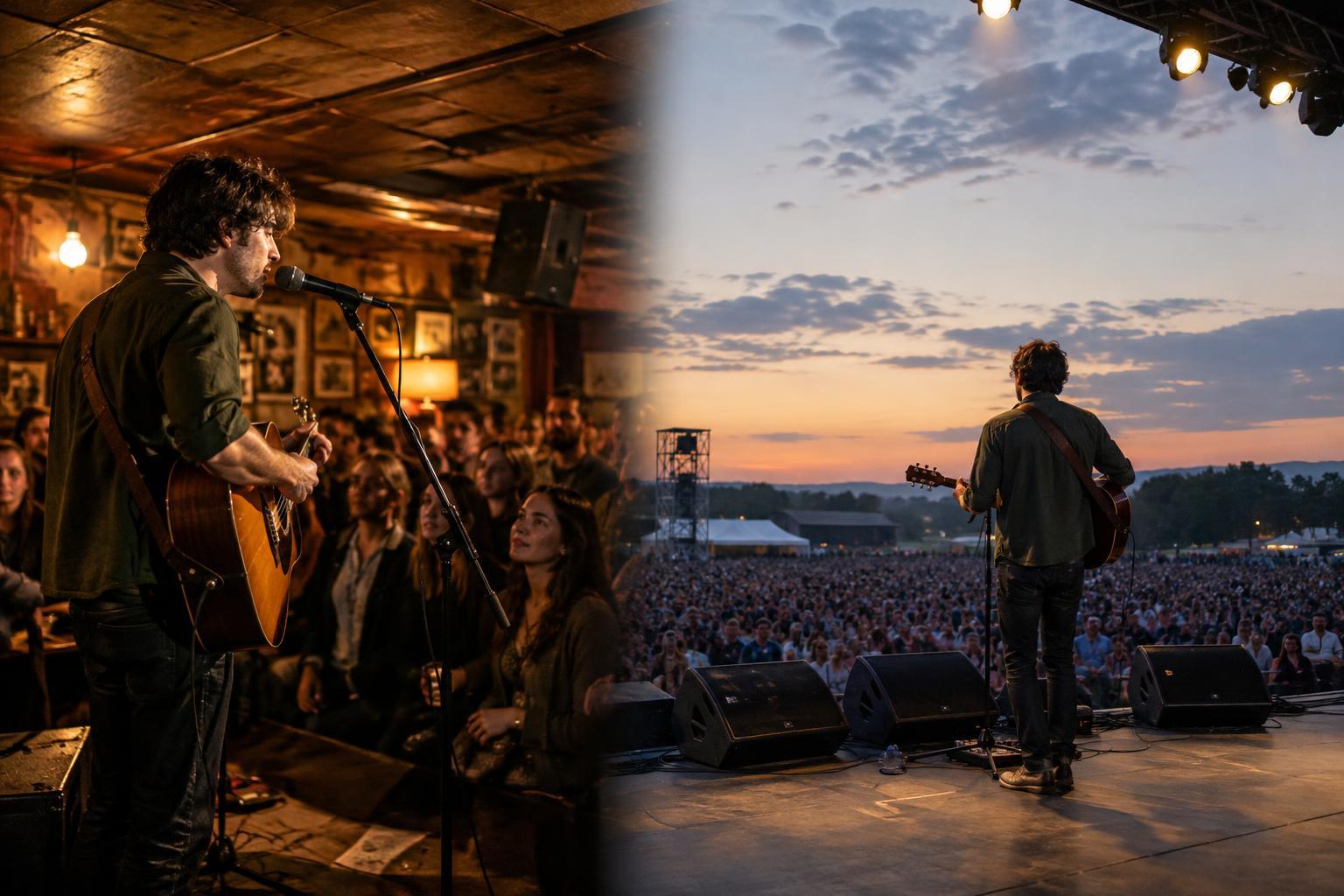
The room changes the conversation
In a small club, performers and listeners often share a remarkably direct experience. A quiet lyric can draw people closer, while a joke between songs may land without much effort. The audience can see small gestures and hear some sounds straight from the stage. That closeness can make a set feel conversational, but it can also make distractions obvious. A loud conversation near the front or a moment of uncertainty between songs may be hard to ignore.
On a large stage, the distance can alter that exchange. Performers may see a crowd rather than individual faces, and a subtle expression might not reach the back. Clear introductions, purposeful pauses and visible cues between bandmates become more useful. This does not mean every movement must be exaggerated. It means asking which parts of the performance need help crossing the space, then keeping those choices consistent with the music.
Sound behaves differently at each scale
A compact room can blend amplified sound with the natural volume of drums, guitar amps and voices. That blend may feel energetic, but it can become crowded quickly. If an amp is too loud for the space, turning up everything else may not restore clarity. Performers can help by agreeing on stage volume, leaving room in their arrangements and listening for whether the vocal remains understandable.
On a larger stage, players may be spread farther apart and hear less of each other directly. Monitors or in-ear systems can become central to staying together, while the audience hears a separate mix through the main sound system. A performer’s position onstage may sound very different from the audience’s position. In either setting, a concise soundcheck is more useful than chasing perfection: play representative parts, explain specific problems and avoid changing equipment settings without telling the sound crew.
Movement needs a new sense of scale
In a club, a step toward the edge of the stage can create a strong connection. There may be little room to roam, especially when cables, pedals and other players occupy the same few feet. Staying aware of those boundaries can look more confident than trying to fill space that is not there. Small choices—turning toward a bandmate for a transition or stepping back during a solo—can give the set shape.
A large stage offers more room, but empty space does not automatically make a show feel bigger. Performers may need to decide when to move closer together, when to use a runway or side area if one is available, and when to stay planted. Rehearsing a few transitions can prevent long, uncertain walks between positions. Movement works best when it supports a musical moment rather than competing with it.
Timing and audience connection take planning
A club crowd may respond immediately, letting a performer adjust a story, extend a musical passage or move briskly to the next song. In a larger space, reactions can be harder to read from the stage. Performers may benefit from trusting the planned arc of their set instead of judging every song by the response they can hear. An audible pause after a song may simply be part of how the space feels from their position.
Between-song talk also changes with scale. A familiar aside can be charming in a small room, while a brief, clearly delivered introduction may travel better across a larger one. Neither approach requires a scripted personality. It helps to know what a song needs from the moment before it: a little context, a clean count-in or no introduction at all. That decision gives the audience a clearer path through the set.
Prepare for the stage you have
Good preparation starts with practical questions. How much space is available? Where will performers enter and place equipment? What monitoring is provided, and how much time is available for setup and soundcheck? Knowing the answers helps a band choose a workable stage layout and avoid last-minute surprises. If details remain unclear, a simple, flexible setup is often easier to adjust than one that depends on a particular room.
It can also help to rehearse the set under different constraints: closer together, farther apart, with less room to move or with limited ability to hear acoustic sound from bandmates. The goal is not to make every venue feel the same. A strong live performance responds to its setting. The small club rewards attention to detail and intimacy; the large stage asks performers to carry those same intentions across more space.