Why an instrument change needs its own plan
An instrument change can be a small moment in a live set, but it involves several tasks at once. A performer may need to put down one instrument safely, pick up another, check its tuning or settings, and get back into position. Meanwhile, bandmates and anyone handling the sound need to know which instrument is coming next. If each person expects a different sequence, a short change can turn into an awkward wait.
Planning does not mean making every transition elaborate. The goal is to remove avoidable decisions from the moment itself. Before a show, performers can note which songs require a switch, what equipment each switch involves, and whether the next song can begin while someone is still getting ready. A simple plan gives the change room to happen without making it the center of attention.
Set up the stage for easy movement
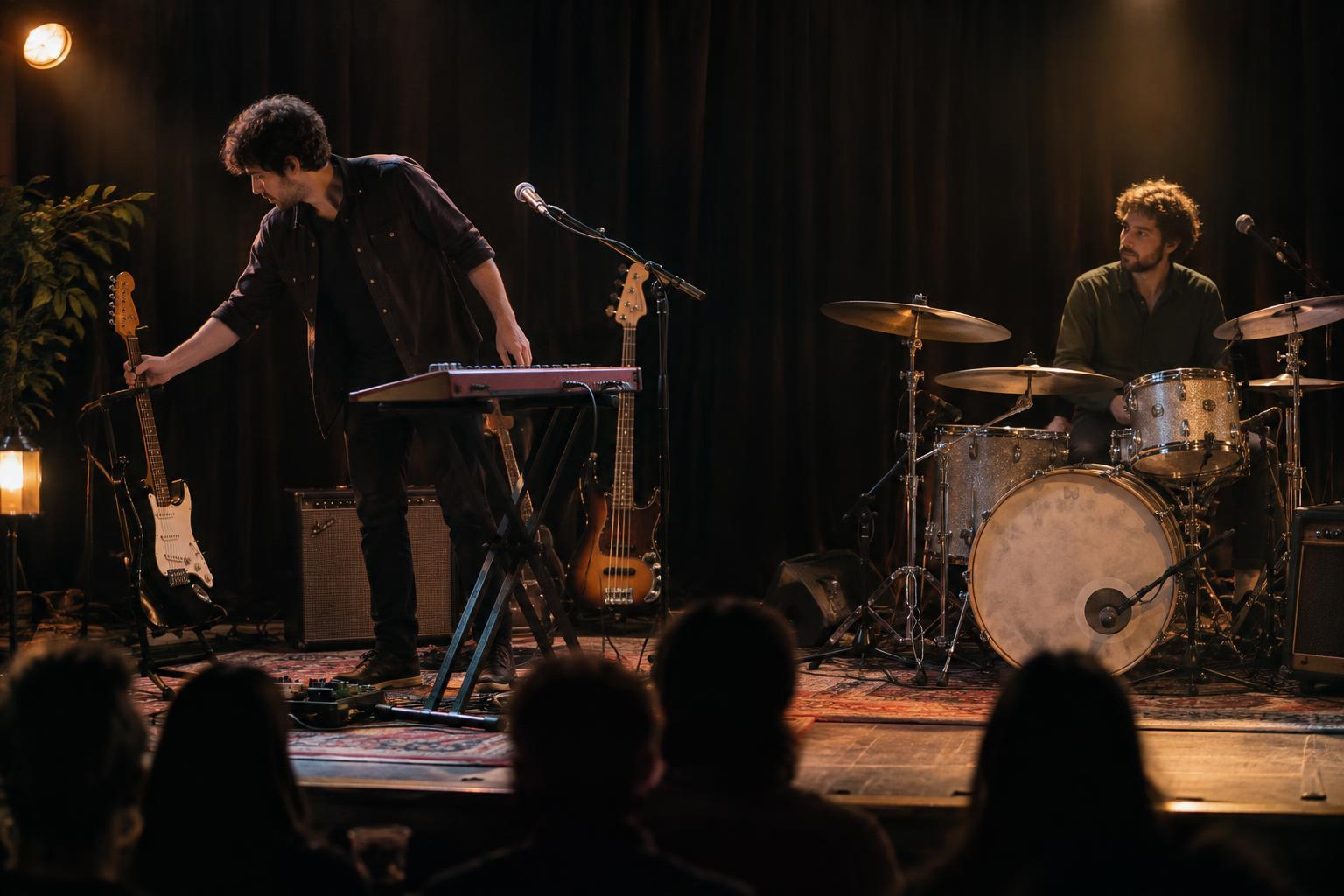
Instrument placement matters as much as speed. A stable stand within comfortable reach lets a musician set an instrument down without rushing or leaning across cables. The next instrument should be accessible without blocking another player’s path. If a strap, cable or wireless pack must be moved, performers can rehearse that sequence in the same order they intend to use on stage.
For instruments with different outputs or settings, the change also has a sound component. An acoustic guitar and an electric guitar, for example, may call for different input levels or effects. Performers can identify those differences during sound check and agree on a reliable way to indicate which setup is active. They should also know whether an instrument needs to be muted before it is unplugged. The smoother transition is not necessarily the fastest one; it is the one that avoids a sudden noise, a tangled cable or a missed entrance.
Give the rest of the band a clear cue
A switch is easier when everyone knows when the next song begins. The cue might be a nod from the musician changing instruments, a count-in from the drummer, or a brief spoken introduction from the singer. What matters is that the cue means the same thing to everyone. If one player treats a glance as a signal to start while another is still checking a connection, the transition can feel hurried.
Bands can practice these moments alongside the songs. Instead of stopping rehearsal after the final chord, they can continue through the instrument change and into the next opening. That reveals practical problems: a stand on the wrong side of the stage, a cable that does not reach, or a count-in that comes too soon. Rehearsing the space between songs helps musicians treat it as part of the performance rather than as downtime.
Use the pause without filling every second
A short pause can give an audience time to take in the song that just ended. It does not always need a speech or a musical interlude. If a change will take longer, another performer can introduce the next piece, acknowledge the room or play a brief passage that leads naturally into it. The best choice depends on the tone of the set: quiet music may benefit from a calm pause, while an energetic run of songs may call for a more deliberate bridge.
Performers should avoid using a transition to make promises they cannot keep, such as announcing that they are ready before a setup is complete. A few extra seconds to confirm tuning and position are usually less distracting than stopping a song after it starts. The audience does not need to see every piece of coordination, but it can sense when the group is comfortable with the pace.
Prepare a fallback for the unexpected
Even a rehearsed change can run into a loose connection, a misplaced pick or an instrument that needs another moment of tuning. A fallback can be modest: the singer holds the introduction, another player extends a soft passage, or the band waits for an unmistakable ready signal. Agreeing on that response beforehand prevents several musicians from trying to solve the same problem in different ways.
After a show or rehearsal, it is worth noticing which switches felt easy and which interrupted the flow. Moving a stand, changing the song order or simplifying an equipment step may solve more than practicing a faster handoff. When instruments, people and cues all have a clear place, a change can feel like a natural part of the set rather than a break from it.