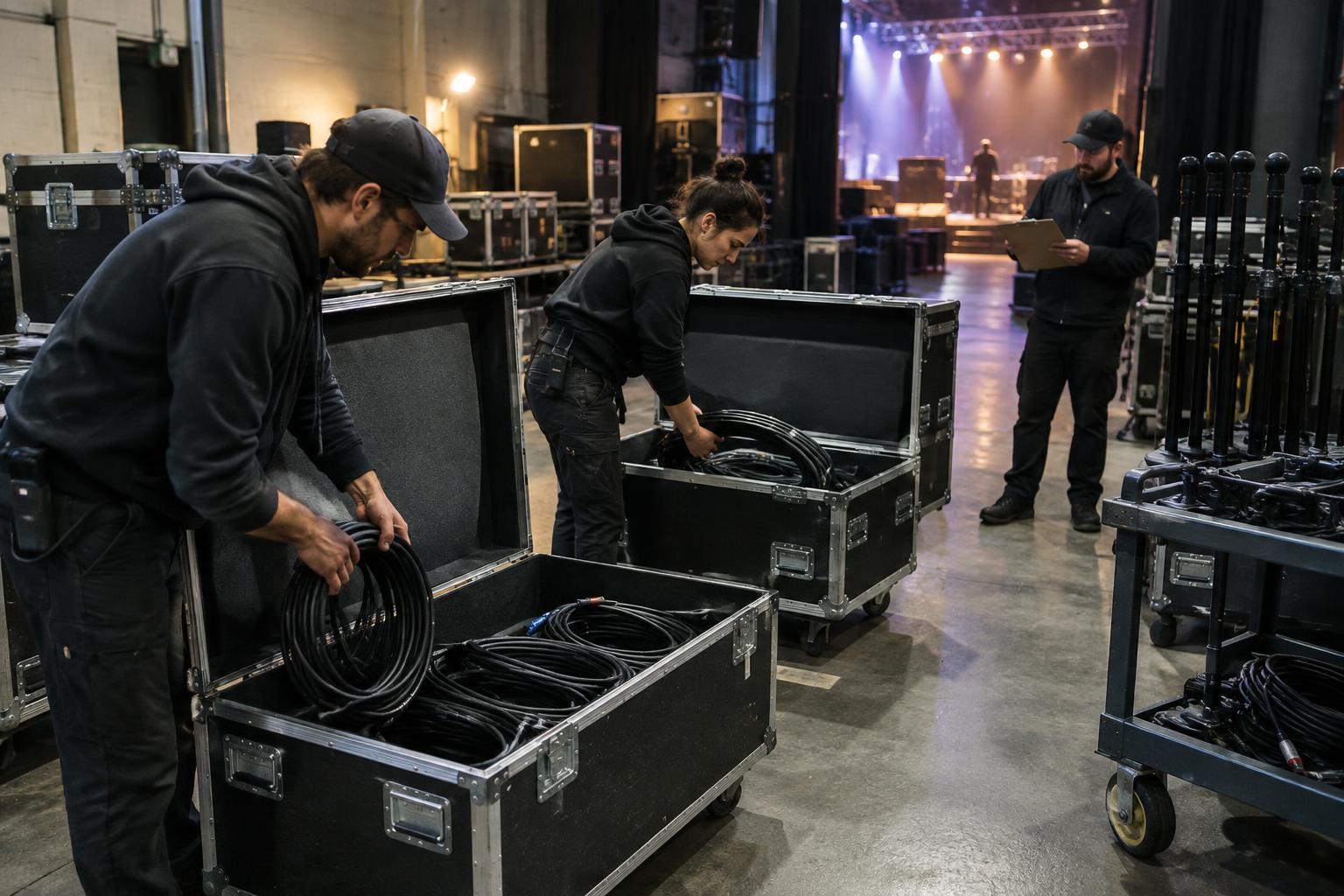
Packing starts before the show ends
For a touring production, packing is more than putting equipment into whatever case is nearby. The crew needs to know which items belong to the tour, where they fit and what will be needed first at the next venue. Those decisions can affect how smoothly the next load-in goes, especially when several departments are working in the same space.
A useful packing plan accounts for the show as it is actually performed. A microphone may move to a different stand during the set; a spare cable may end up at the side of the stage. Crews often build checks into their routine so those items are found before cases are closed, rather than discovered missing after the truck has left.
Cases give every item a place
Road cases protect equipment during handling, but they also act as a storage map. Compartments, padded spaces and smaller containers help keep related pieces together. A lighting fixture, for example, may travel with its usual accessories, while small audio adapters may be grouped in a clearly identified drawer or pouch.
Labels help people identify a case without opening it. They can show its department, contents or intended destination within the venue. Consistent naming matters: if one label calls a case “stage power” and another list calls it “cables,” a crew member may have to stop and search. A label is most useful when it matches the way the crew talks about and tracks the gear.
Not everything is packed the same way. Fragile items need protection from movement, while frequently used supplies should be easy to reach. The aim is not to fit the most gear into each case; it is to make the contents reasonably secure and straightforward to unpack, use and return.
The load-out is an inventory opportunity
After a performance, different teams may be breaking down equipment at once. A consistent order helps keep loose items from disappearing into the bustle. Crew members might gather accessories from their work areas, return them to assigned containers and check cases before they are moved away. The exact routine depends on the production, but the principle is simple: confirm what has been collected while the stage is still accessible.
An inventory does not have to mean counting every connector from scratch after every show. A case checklist, a marked storage space or a count of higher-value items can help a team notice a discrepancy. When something is absent, it is easier to retrace its last use while the people and spaces involved are still available.
It also helps to separate missing gear from gear that is present but needs attention. A damaged stand or a cable that has begun to fail should not quietly return to the same place as ready-to-use equipment. Marking it for inspection or repair gives the next crew a clearer picture of what they can rely on.
Packing order shapes the next load-in
The order in which cases leave a venue can influence what happens when the tour arrives at the next one. Equipment needed early should be identifiable and accessible under the production’s loading plan. If essential cases are buried behind items used only near showtime, the crew may spend valuable setup time moving things twice.
That does not mean every department can simply demand to load last and unload first. Space, transport arrangements and the next venue’s access all impose limits. A coordinated plan weighs those constraints against the order of work: establishing the stage area, placing equipment and making it ready for later checks. Clear case labels and predictable packing make the plan easier to adjust when conditions change.
A repeatable routine leaves room to adapt
No two venues offer exactly the same route from stage to vehicle. Doorways, lifts, loading areas and available working space can all change how a crew moves its cases. That is why a good routine distinguishes between what should stay consistent—such as where gear belongs—and what may need to change, such as the path or sequence used to move it.
The benefit becomes apparent at the next stop. When equipment returns to familiar places, crew members can find what they need without reconstructing the previous night. Packing rarely draws an audience’s attention, but it is part of the practical work that makes another performance possible.