The day begins before the doors open
For an audience member, a concert often begins when the house lights dim. For the people building it, the day starts much earlier. The exact schedule depends on the venue, the size of the touring party and how much equipment is already in place. A small club may have a compact crew and a quick changeover; a larger production may bring trucks, specialized departments and a detailed sequence for getting everything inside.
Before gear moves onto the stage, venue and touring staff usually compare the plan with the room as it stands. They identify where cases can travel, where equipment will be stored and which areas need to remain clear. This coordination is less glamorous than a lighting cue, but it prevents one team’s work from blocking another’s. A good production day is not simply fast: it gives people enough room and time to do their jobs.
Load-in turns a plan into a working stage
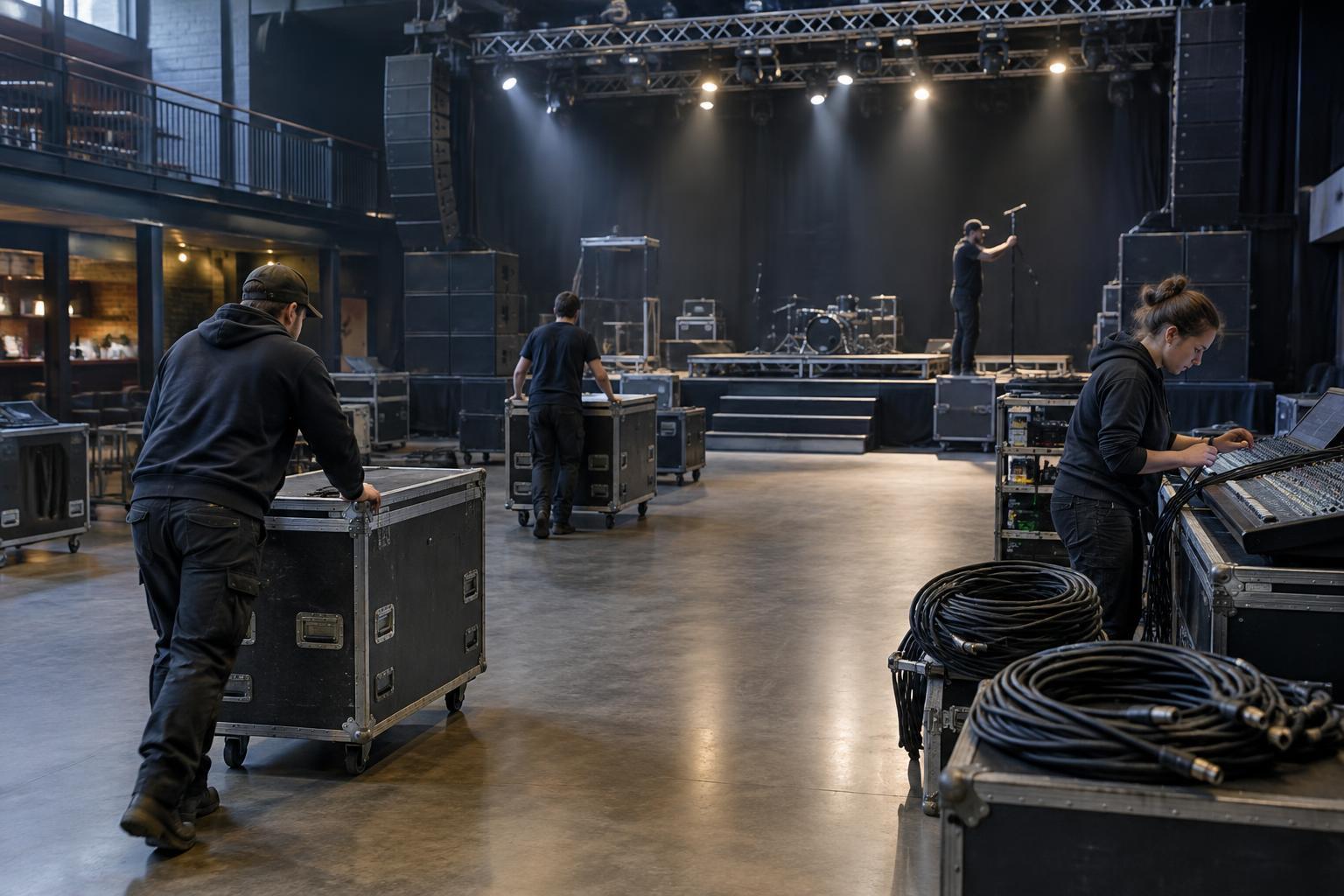
Load-in is the movement of instruments, audio equipment, lighting gear, scenery and supplies from vehicles or storage areas into the venue. Cases arrive in an order that matters. Equipment needed to build the stage generally has to be accessible before the items that sit on top of it. While one group positions risers or backline—the amplifiers, drums and other equipment used by performers—another may begin preparing cables, microphones or lighting fixtures.
The stage gradually changes from an empty platform into a collection of connected systems. Audio needs signal paths from microphones and instruments to mixing positions and speakers. Lighting needs fixtures, power and control. Performers need practical places for instruments, monitors, water and safe movement. Departments work in parallel where they can, but they also depend on each other: a microphone cannot be placed accurately if a drum kit has not reached its final position.
Soundcheck tests more than volume
Once the stage is ready enough to play, the crew checks individual inputs, monitors and the sound reaching the room. A line check confirms that expected signals arrive where they should. A soundcheck, when time allows, lets performers and audio engineers hear those systems working together. Musicians may ask for changes to what they hear onstage, while the front-of-house engineer adjusts the balance intended for the audience.
Lighting and other show elements may be tested during this window, too. The purpose is not to make every moment of the performance predictable; live music rarely works that way. It is to catch avoidable surprises, learn how the room responds and establish a shared starting point. In some settings, performers have little or no full soundcheck, so crews rely more heavily on preparation and brief checks between acts.
Showtime is active work behind the scenes
When doors open, the production day shifts rather than pauses. House staff welcome the audience while stage and technical crews keep track of what is happening onstage and what must happen next. During the performance, audio engineers respond to changes in playing and singing, lighting operators follow cues or the feel of the set, and stage crew members stay ready for instrument changes or other planned moves.
On a multi-act bill, changeovers can be especially demanding. One setup must leave the stage while the next arrives, often with little time to spare. Clear labeling, agreed positions and calm communication help make that transition possible. To the crowd, a smooth changeover may barely register. Behind the stage, that apparent simplicity is the result of many small tasks completed in the right order.
Load-out closes the loop
After the last song, the production is not finished. Instruments are packed, cables are collected, temporary equipment is taken down and cases move back toward storage or vehicles. Crews check that gear is accounted for and that the venue is left ready for its next use. The pace can feel very different from load-in: the show is over, but careful packing still matters because the equipment may need to work again at the next stop.
Seen as a whole, a concert production day is a chain of handoffs. Load-in makes setup possible; setup makes checks possible; checks support the performance; and load-out prepares the people, gear and room for what follows. The audience hears the result for a few hours. The work on either side of those hours is part of the performance, even when it remains out of sight.