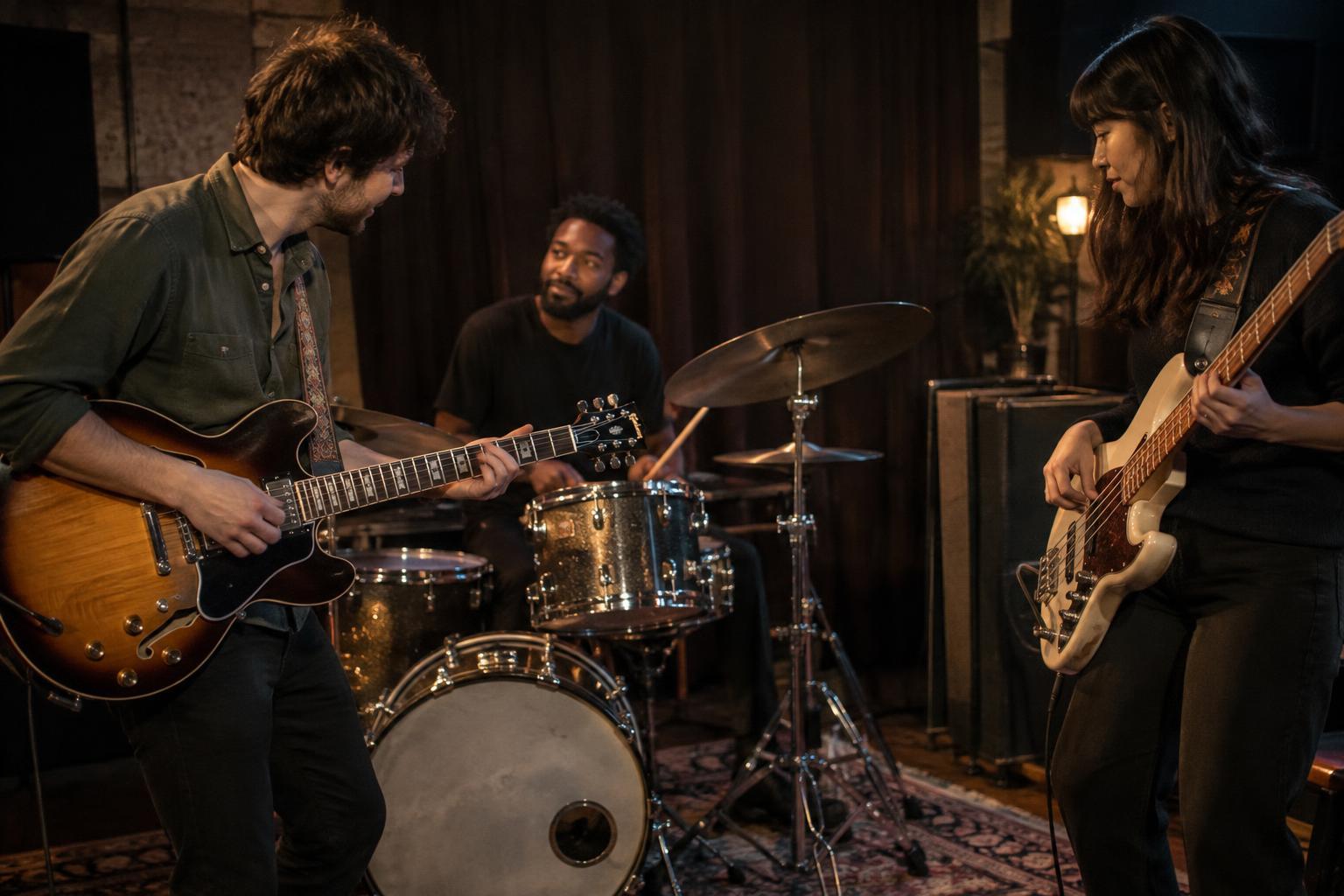
What an arrangement gives the room
An arranged section is a part of a song whose shape has been decided before the performance. The band may know exactly when the chorus returns, where the instruments drop out, or how a quiet passage builds toward a final hit. That shared map helps performers play together with confidence. It also helps an audience follow the song, even when the sound and energy of a live room differ from a recording.
Structure does not have to mean playing every note the same way each night. A singer might change their phrasing while the band keeps the underlying progression steady. A drummer might vary a fill without changing the moment everyone comes back in. The arrangement protects the moments that define the song while leaving smaller choices open.
What improvisation can add
Improvisation is music made through choices in the moment. It might be a long solo, a brief exchange between players, a changed vocal melody, or a groove that continues because the room is responding to it. At its best, it creates a sense that this version of the song could only happen here, with these players and these listeners.
That freedom works best when performers are listening as closely as they are playing. A soloist can respond to a rhythmic idea rather than simply filling available space. The rest of the group can make that idea clearer by holding back, repeating a figure, or changing the dynamics. Improvisation is not necessarily louder, faster, or longer than the arranged material; sometimes the most effective choice is to leave a pause.
Choose the boundaries before stepping outside them
The useful question for a live set is often not whether to arrange or improvise, but where each approach belongs. A band might keep the opening and ending of a song fixed, then leave a middle section open. Another might agree on a chord sequence but let one performer decide when to pass the lead to someone else. These boundaries give players a way to take risks without making every transition a guess.
Simple cues are especially helpful in an open section. A repeated riff can signal that the song is heading back to the chorus; a drum pattern or a clear gesture can prepare the group for an ending. The cue matters less than everyone recognizing it. Rehearsal can then focus on how to enter and leave the flexible passage, not on scripting everything that happens inside it.
Think about pacing across the whole set
A compelling solo can lose its impact if every song stretches in the same way. Placing an open passage between more direct songs can make the contrast feel intentional. Likewise, a tightly arranged ending can bring the audience back to a strong shared moment after an exploratory section. Set pacing gives both approaches a reason to be there.
The room can influence those choices, but it may not give an obvious answer. Listeners dancing to a groove may welcome another cycle; a quiet, attentive crowd may be ready for a softer detour. Performers can notice those responses without treating them as instructions. Having a planned short route and a planned extended route makes it easier to adapt while keeping the set moving.
Listen for the handoff
For concertgoers, the shift between arrangement and improvisation is part of the pleasure of live music. Notice when a familiar phrase changes, when one player offers an idea and another answers it, or when the group finds its way back to a recognizable section. Those handoffs can reveal how much communication is happening onstage, even without a spoken word.
For performers, the same moments are a practical test: does the open section deepen the song, and does the return feel earned? If a passage repeatedly wanders without adding much, it may need a clearer purpose or an earlier exit. If an arrangement feels too rigid, one small opening may give it fresh energy. The strongest live sets do not have to choose between precision and surprise. They use each to make the other more noticeable.